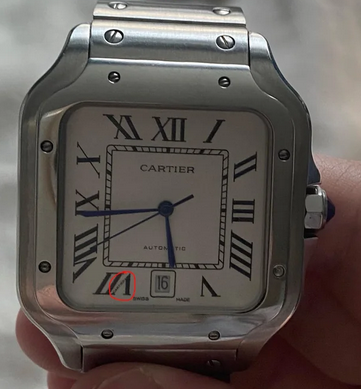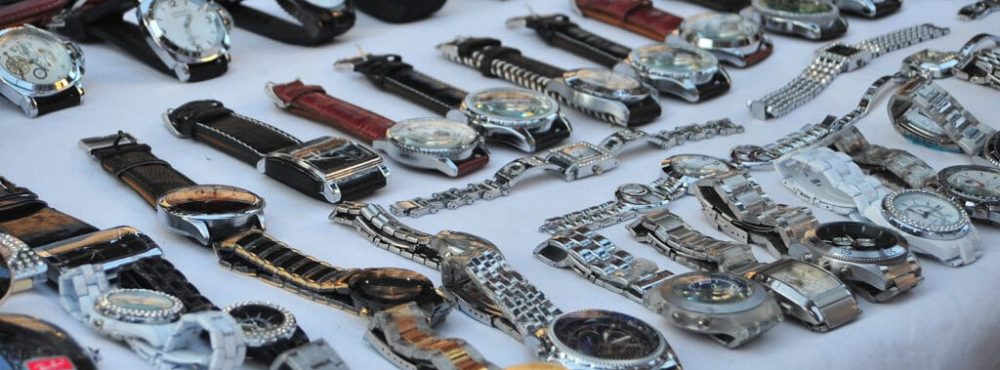
I wanted the “Jeweller of Kings.” Instead, I got a wobbly bezel, a blue bruise on my wrist, and the shortest honeymoon in watch history.
The Seduction
The Cartier Santos is supposed to look good on anyone. It’s timeless, elegant, and—on a genuine model—beautifully understated. The problem? The real thing starts at £6,000+ in the UK.
So when a targeted Instagram ad offered a “Swiss Grade 1 Santos Clone” for £395, my brain stopped working. The website was called luxury-clones.co (red flag #1). The photos were gorgeous (red flag #2). And the chat agent promised: “Same 316L steel. Same blue hands. Same weight. You will not be disappointed.”
I was disappointed before the watch even arrived. I just didn’t know it yet.
The Unboxing (A Slow-Motion Disaster)
The package came in a nondescript envelope. No Cartier box. No cushion. Just the watch wrapped in bubble wrap, rattling like a maraca.
First problem: The bezel had scratches. Fresh out of the wrapper. Not micro-scratches. Actual gouges near the 7 o’clock screw.
Second problem: The signature blue cabochon on the crown wasn’t a gemstone. It was blue plastic. I know because I scratched it with my fingernail.
Third problem: The bracelet links were sharp. Like, cut-your-cuff sharp. Cartier bracelets are famous for being silky smooth. This one felt like it was made from recycled razor blades.
The Wrist Test (3 Days of Regret)
I wore it for three days. Here’s what happened:
- Day 1: The butterfly clasp popped open while I was typing. Twice.
- Day 2: The “blue steel” hands started showing tarnish—a foggy, dirty look around the edges. Real Cartier blue hands remain perfect for decades.
- Day 3: I developed a green stain on my wrist. Cheap brass base metal reacting with sweat. Classy.
A colleague spotted it from across a meeting table. “Is that a Santos?” she asked. I felt my face go red. She didn’t even need to see it up close. The light reflection was wrong. The polished surfaces looked cloudy, not crisp.
The Customer Service Wall
I emailed the seller. Polite. Photos attached.
Reply: “Please send video.”
I sent a video showing the green stain, the popped clasp, and the scratched bezel.
Final reply: “This is normal. You paid £395, not £6000. What did you expect? If you want perfect, buy real Cartier. No refund. No return.”
They weren’t wrong. They were just honest in the cruelest possible way.
The Verdict: Worthwhile or Waste?
Waste. Complete waste.
| What They Promised | What I Got |
|---|---|
| 316L steel | Plated brass (green wrist included) |
| Blue stone cabochon | Blue plastic |
| Smooth bracelet | Sharp, dangerous edges |
| Secure clasp | Pops open randomly |
| You won’t be disappointed | I was embarrassed |
£395 could have bought a genuine Tissot PRX (quartz), a Seiko 5, or a very nice Citizen. Instead, I bought a watch that stains my skin and announces my bad decisions to anyone within 2 metres.
Final Thought
The Cartier Santos is beautiful. A £400 replica of a Santos is not.
If you can’t afford the real one, buy something else. But don’t buy a fake. Because the only person you’re fooling is yourself—and even you won’t believe it for long.
Rating: 0/10. Would not buy again. Would not wish on an enemy.